 Pango Pockets
What is financial literacy for kids?
Financial literacy is knowing how to earn, save, spend, share and protect money well. For kids it is not about spreadsheets or the stock market. It is a handful of habits and ideas that grow with them:
- Money is swapped for things, and it comes from work.
- Needs come before wants, and wants can usually wait.
- Saving lets you afford something bigger later.
- A budget is a plan for money before you spend it.
- Prices can trick you, so compare before you buy.
- Giving feels good and is part of using money well.
- Scams exist, and you always ask a grown-up first.
The best way to teach kids about money is little and often: two-minute chats at the supermarket, the food court or the dinner table, plus a few hands-on routines like a savings jar. Kids learn far more from handling small amounts of real money, and making small mistakes with it, than from being told.
Money skills by age
Every child is different, so treat these as a rough guide rather than a checklist. Start where your child is and move on when it feels easy.
Ages 5 to 7: what money is
- Coins and notes have different values, and money is swapped for things we need or want.
- Needs come first, wants can wait.
- Waiting a little can get you something better: the first taste of saving.
- Money comes from work. Grown-ups earn it, it does not come from the ATM or the phone.
Try:
Need or Want? gameSpend, Save, Share Jar KitMoney word: SavingMoney word: Earn
Ages 8 to 10: choices and plans
- Save for a goal over several weeks and track progress.
- Plan a small budget, like $10 for an outing, and stick to it.
- Compare prices and notice sale tricks before buying.
- Pause before impulse buys, and choose to give some money away.
Try:
Pasar Malam $10 ChallengeSpot the Sale TrapPango PassportMoney word: BudgetMoney word: Impulse buyingMoney word: Generous
Ages 11 to 12: the bigger picture
- Manage a weekly allowance that covers real costs, like recess food.
- Understand interest (money that grows) and inflation (prices that rise).
- Keep an emergency fund for the unexpected.
- Spot scams, in-game purchase traps and “too good to be true” offers online.
Try:
Money word: InterestMoney word: InflationMoney word: ScamHoliday Fun Plan
Child 10 or older? See Money for older kids (10 to 14): real budgets, compounding, investing basics and online money traps.
10 easy money activities for families
None of these need special kit. Pick one a week and keep it light.
Set up three jars
Every time money comes in, split it into Spend, Save and Share. Kids can see saving and giving happen. Our Jar Kit has labels for three age groups.
Be a supermarket detective
At the supermarket, give your child two brands of the same thing and ask which is better value. Look at the price per 100g together.
Plan a $10 food court meal
Hand over $10 at a food court or hawker centre and let your child plan a meal and a drink within it. If there is change, they decide what happens to it.
Make a gift-money plan
Before birthdays and festivals (red packets at Chinese New Year, Hari Raya, Diwali, Christmas or Eid), agree how much goes to saving, spending and sharing. Count it together afterwards and stick to the plan.
Keep a wait-list
When your child wants something, write it on a list and wait seven days. If they still want it, talk about how to save for it. Many wants quietly disappear.
Ask the grandparents
Ask Grandma or Grandpa (Ah Ma, Nenek or Paati) what a plate of noodles or a bus ride cost when they were young. It is the friendliest way to explain inflation.
Run a lunch-money budget
For older kids, give snack or recess money for the whole week on Monday instead of daily. They learn to plan so Friday is not a hungry day.
Make cashless visible
When you tap a card or pay by phone or QR code, say the amount out loud and show your child the receipt or notification. Money that is invisible is easy to overspend.
Spot the scam at dinner
Read a real scam text message or ad together (with personal details removed) and find the trick: a rush, a prize, a request for a code. Then read our Scam page.
Earn something extra
Agree on a few extra jobs, beyond everyday family chores, that earn a small amount. It connects money to effort. See Earn and Income.
Why financial literacy matters for kids today
Pocket money starts early. Many children buy their own snacks or school food from a young age. That daily choice between a treat, a drink or saving the change is a real budget, and a great place to start.
Gift money arrives in big lumps. Birthdays and festivals can bring more money than a child sees all year, whether it comes in red packets, green packets or birthday cards. A simple plan before the day turns it into a lesson instead of a spree.
Money is becoming invisible. Between cards, phones and QR codes, kids rarely see notes and coins change hands. Saying amounts out loud and showing receipts helps them understand that tapping is still spending.
Scams and in-game spending are everywhere. Scam messages, fake deals and pay-to-win games target kids with phones and game accounts. Simple rules learned early (never share codes, slow down when someone rushes you, always ask a grown-up) protect them for life.
In Singapore? Pango Pockets is made here, so you will spot hawker centres, ang bao and pasar malams in our games. Grown-ups can find official scam warnings at ScamShield, and turning CDC Voucher shopping into a family budgeting chat is a great real-life lesson.
How to use our free games, printables and money words
Everything on Pango Pockets is free, with no sign-up and no ads. Here is how each piece fits the skills above.
Free money games for kids (2 to 3 minutes each)
See every game, including new ones as they launch, on the games page.
Free printables for the fridge
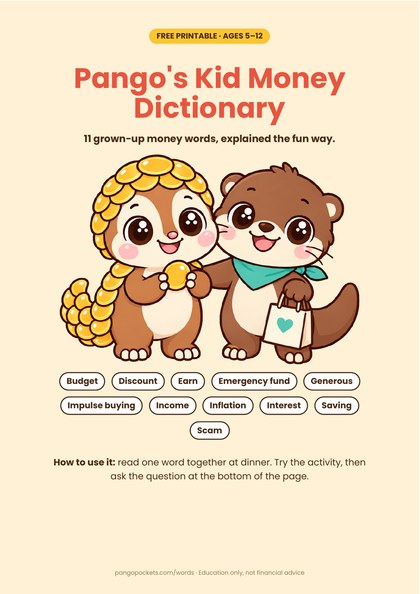 Kid Money DictionaryAges 5 to 12 · free PDF
 Spend, Save, Share Jar KitAges 5 to 13 · free PDF
 Pango PassportAges 5 to 10 · free PDF
 Holiday Fun PlanAges 5 to 12 · free PDF
 Light-Up Savings TrackerAges 5 to 10 · free PDF
Kid Dictionary: money words for kids
One money word a week, explained in kid language with one picture and a question to ask at dinner. Start with these:
Or browse all money words.
Questions parents ask
What is financial literacy for kids?
It is the everyday know-how to use money well: knowing what money is and where it comes from, telling needs from wants, saving for a goal, sticking to a small budget, comparing prices, giving, and spotting tricks and scams. For kids it is less about numbers and more about habits and good questions.
What age should I start teaching my child about money?
Around 5 is a good time to start. Young kids can learn what coins and notes are, that money is swapped for things, and that waiting can get you something better. From about 8 they can save for a goal over weeks and follow a small budget. By 11 or 12 they are ready for ideas like interest, inflation and online scams.
How much pocket money should a child get?
There is no single right amount. Start from what the money has to cover, such as school snacks or a weekly treat, pay it on a regular day, and let your child keep a small part to save. Raise it when they take on more of their own spending.
Is financial literacy taught in schools?
In most countries, only a little. Money usually comes up in maths lessons as adding up prices and giving change. Everyday money habits like saving, budgeting, resisting impulse buys and spotting scams are mostly learned at home, which is why short, regular family conversations help so much.
How do I teach kids about money when we mostly pay by card or phone?
Say out loud what is happening when you tap or scan: how much it costs, where the money comes from and how much is left. Let your child check a receipt or the payment notification with you, and use real coins and notes for their own pocket money and savings jar so they can see money going in and out.
How can I teach my child to spot scams?
Keep the rules simple: never share passwords or one-time codes, be suspicious of anything urgent or too good to be true, and always ask a grown-up before clicking a link or paying. Look at real scam messages together and talk about the trick in each one.
Are Pango Pockets games and printables really free?
Yes. Every game and printable on this site is free for families and classrooms, with no sign-up and no ads.

Follow for a new idea every day
A new idea every day on Instagram, TikTok and Threads.
Follow @pangopockets on Instagram